It’s a rough estimate, but on average, one page of screenplay loosely translates to one minute of screen time. Obviously, there are exceptions, but this guide helps readers estimate a script’s runtime based on the page count.
If you’re writing a half-hour script, studios want 24-32-page scripts. An hour-long pilot = 60 pages, a feature = 90-110, etc. For shorts, 1-15 pages is the sweet spot. The more films a festival can cram into a program, the better, so why select one 40-minute short over four 10-minute ones?
This guide is also extremely useful when trying to keep the visuals in mind when writing. A minute may not sound like it, but it’s a loooong time when staring at a screen, and if there’s a lot of talking happening in your script, you’d better be making sure there’s something interesting happening to keep the audience's eyes busy while listening.
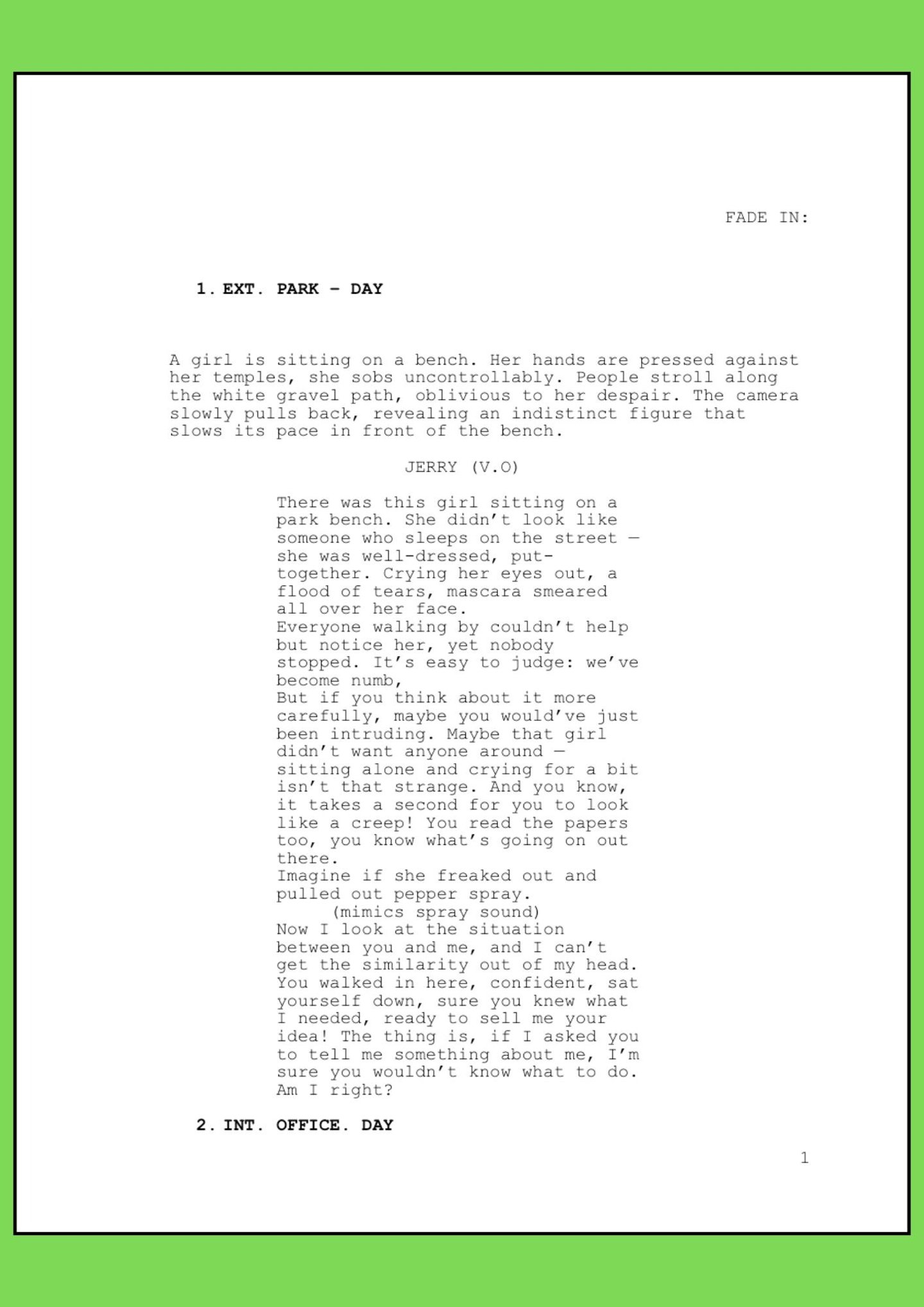
Here’s an example:
Forget the poor formatting for a second and look at that massive monologue.
Does it ramble? Yes. There’s definitely scope to trim it back to be more succinct and impactful, but for argument’s sake, let’s say it’s all essential stuff as it’s helping define the character and giving us some much-needed setup.
Go read it.
Actually read it OUT LOUD.
And TIME how long it takes you to speak those lines.
It took me about a minute, but that wasn’t with a nuanced delivery with pauses, like a proper actor would take the time to finesse; it was a basic read-through.
Now sit for the same amount of time and imagine you are looking at the imagery given in the scene description.
Watching a girl on a bench sobbing with a slow pull back to reveal another person isn’t going to take a whole minute, is it. And suddenly, that one minute feels like an absolute eternity.
When a reader sees a scene like this, they know that the writer isn’t thinking VISUALLY. And that’s kinda what film is all about. The clue is in the name. Movies are supposed to…. move.
Without something to keep the viewer’s eyes busy, they could easily tune out and miss pivotal exposition, or worse, disengage altogether.
THE FIX?
Cutting dialogue back to the bone is the first step. Figure out what needs to be conveyed, and get rid of the rest. Avoid giving the same statements, just using different words. That repetition is slowing the pace.
Ending on the most powerful line possible is what packs an emotional punch while also leaving the reader excited to turn the page to find out what happens next.
Consider breaking up large paragraphs of dialogue with action, reactions, imagery, or movement.
What are the other characters in the scene doing? Are they at all impacted by the dialogue being said?
What imagery would juxtapose well with the info being given?
Can you show any exposition instead of telling it to us?
What is the character who is delivering the speech doing while they’re talking? Would talking while doing something else add another layer (even just walking and talking helps make a shot more dynamic), or is being stagnant pulling more focus on the words?
What could be happening in the background to keep our eyes busy? (This works particularly well in comedy)
Yes, there’s absolutely a time and place for monologues, but that doesn’t mean you can’t also use the visuals to enhance the story at the same time. Figure out what’s going to be more engaging for the audience, and go from there.